
The logic of wealth concentration
In 1820, the finest blacksmith in western Massachusetts could shoe perhaps twenty horses in a day, assuming good weather and steady customers. His income reflected this direct relationship between skill, effort, and output – a connection so fundamental that it had governed human economic life since the dawn of agriculture. By 1890, Andrew Carnegie’s steel mills employed thousands of men producing more metal in a single day than entire medieval kingdoms had forged in a century. Carnegie’s personal wealth from this operation exceeded the combined treasuries of most European nations.
Something had shifted in the basic mathematics of human productivity, but the change went deeper than mere efficiency gains. For the first time in history, wealth accumulation had broken free from the ancient constraints that had limited even the most successful individuals to fortunes measured in multiples, not exponentials, of ordinary income. This transformation was just beginning.
Consider what constrained the rewards of labor in pre-industrial societies. A master craftsman’s income remained tied to the shoes he could personally make, the customers he could personally serve – no amount of skill could multiply his daily output beyond the limits of human hands and hours. A merchant’s profits were bounded by the deals he could personally negotiate, the shipments he could personally oversee – expanding meant working proportionally harder or longer. Even a successful farmer’s harvest reflected the acres he and his family could tend – doubling income meant doubling effort and land. The relationship between work and reward remained intuitive because human labor, however skilled, could only generate proportional returns.
The relationship between effort and reward remained intuitive because it remained personal. The blacksmith’s reputation mattered. His particular skill in tempering iron, his relationships with local farmers, his reliability during harvest season – these individual qualities determined his income. Customers sought him out specifically. If he fell ill, no one else could easily substitute for his particular combination of skill and local knowledge.
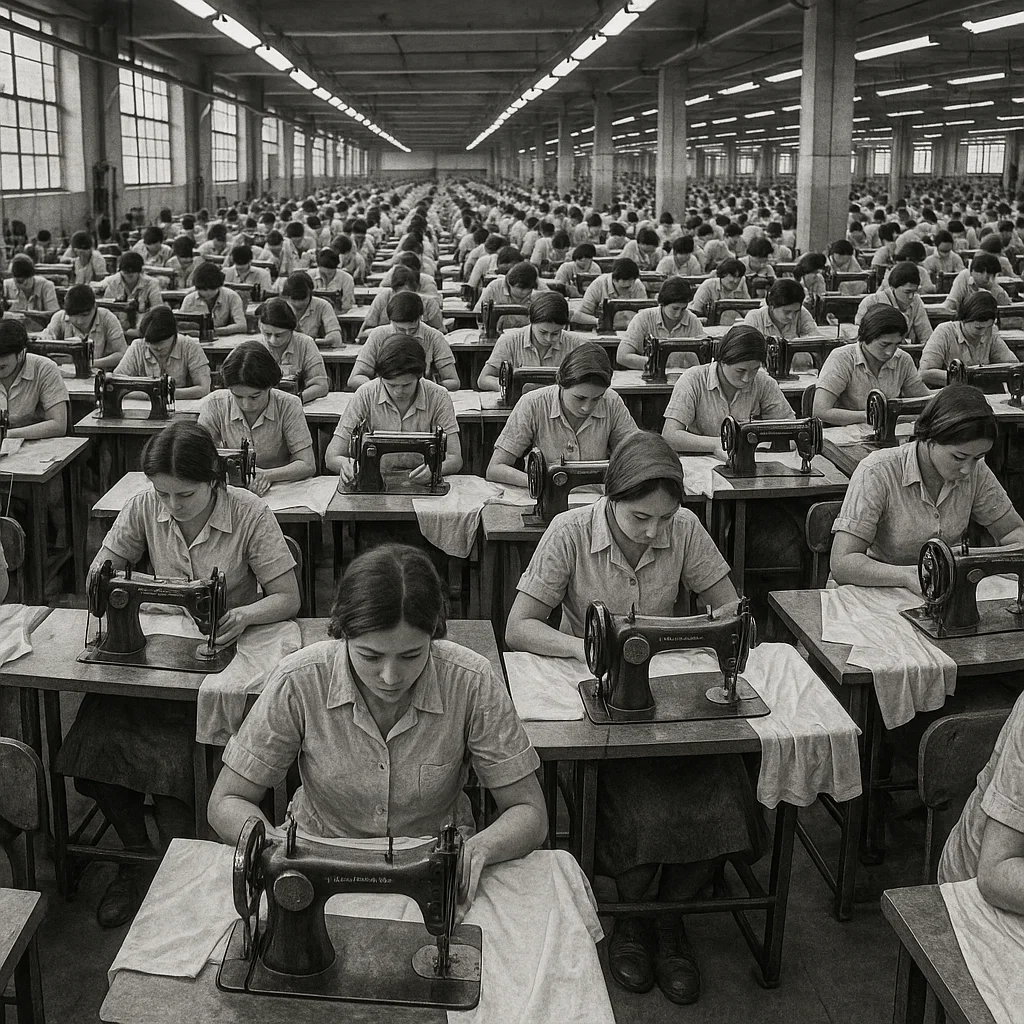
Industrial technology shattered these ancient limitations through a double transformation that was occurring simultaneously across industrializing nations: it amplified human labor exponentially while simultaneously making individual workers replaceable. A single steam engine didn’t just replace one horse – it could power machinery that multiplied human productivity by factors that had no historical precedent. But critically, it also standardized and depersonalized the work itself. The power loom operator required minimal training and could be easily replaced by any other worker. Individual skills and reputations became irrelevant within technological systems that could operate at truly national scale.
This represented a qualitative break from all previous economic experience. For thousands of years, expanding production meant adding proportionally more skilled individuals. A medieval guild grew by training more apprentices who would eventually become master craftsmen in their own right, each commanding individual respect and wages commensurate with their personal expertise. But a textile factory could expand by adding interchangeable workers to operate identical machines – more production, same wage levels, no increase in individual worker value.
The cotton mills of Lowell, Massachusetts, demonstrated this new mathematics with startling clarity. A skilled hand-weaver working at home had commanded premium prices for her particular expertise and could set her own terms with customers who valued her individual work. But a textile factory employing hundreds of workers using power looms could undersell every hand-weaver within a hundred-mile radius while paying each factory worker a fraction of what the hand-weaver had earned. The factory owner wasn’t working harder than individual weavers – he was extracting what economists call “rent”: income that flows from controlling essential resources or infrastructure rather than from proportional labor or contribution. In this case, the rent came from owning the technological systems that had made personal weaving skills obsolete and workers interchangeable.
Railroads pushed this logic even further. A railroad company with twice the track mileage didn’t earn twice the revenue – it earned dramatically more. Within ten years of the transcontinental railroad’s completion, it shipped $50 million worth of freight coast to coast annually (roughly $1.6 billion in today’s money), while reducing transportation costs to one-tenth the price of stagecoach transport. Network effects meant that connecting previously isolated markets generated revenues far exceeding what individual shorter lines could achieve. Meanwhile, the individual railroad workers – conductors, engineers, track layers – became fungible components in a vast system, easily replaced and commanding wages that bore no relationship to the enormous wealth their collective labor generated.
James J. Hill’s Great Northern Railway exemplified this transformation. Hill didn’t succeed because he was a better railroad man than his competitors – he succeeded because controlling a continuous line from the Great Lakes to the Pacific Coast created systemic advantages that smaller operations could never match. The wealth this generated for Hill personally bore no relationship to his individual effort. It represented rent extracted from owning infrastructure that had made thousands of workers vastly more productive while simultaneously making each individual worker replaceable and powerless to claim a proportional share of that increased productivity.
By the late nineteenth century, John D. Rockefeller had perfected the art of converting this double transformation into permanent wealth accumulation. Standard Oil succeeded not through superior oil refining – Rockefeller’s refineries were often less efficient than his competitors’ – but through systematic control of the infrastructure that oil had to flow through to reach consumers. More importantly, Rockefeller’s integrated system made individual refinery workers, pipeline operators, and transportation crews into interchangeable parts. Any worker could be replaced without disrupting the system, while Rockefeller extracted rent from controlling the chokepoints through which their collective amplified labor had to flow.
This was the crucial insight that contemporary observers struggled to grasp: industrial wealth represented a fundamentally different category from pre-industrial riches. It wasn’t just that technology had made labor more productive – it had made individual laborers irrelevant while concentrating the value of their amplified productivity into the hands of those who owned the systems. The blacksmith’s personal skills had commanded individual respect and proportional compensation. The steel worker’s labor, however amplified by machinery, commanded only the minimum wage needed to prevent him from leaving for an identical job at an identical factory.
The telephone system revealed the ultimate logic of this transformation. A telephone operator’s work was exponentially more productive than a messenger boy’s – she could connect dozens of calls per hour that would have required dozens of messengers. But telephone operators were completely interchangeable, trained in days, and paid subsistence wages. Meanwhile, the owners of telephone networks extracted enormous rent from infrastructure whose value increased geometrically with adoption, completely detached from the individual contributions of any worker within the system.
What made this transformation so psychologically disorienting was how it preserved familiar moral language while operating according to completely different economic rules. Carnegie and Rockefeller understood perfectly well that they were extracting rent from technological infrastructure that had made individual workers both incredibly productive and completely replaceable. But the broader culture continued to interpret their success through pre-industrial categories of individual merit and proportional reward, even as the underlying relationship between personal contribution and personal compensation had been permanently severed.
What happened was simpler and stranger than anyone realized at the time: technology had quietly rewritten the rules of wealth creation while society kept using the old scorecards.

This same pattern continues today, as digital technology creates new forms of network-dependent wealth that dwarf even the industrial fortunes of the Gilded Age. Platform workers generate enormous value through network effects while remaining as interchangeable and economically powerless as factory workers once were. We still speak of “earning” wealth that actually reflects rent extracted from controlling systems that amplify and depersonalize human labor simultaneously. Understanding this history suggests that our debates about wealth inequality might benefit from acknowledging what the industrial age revealed: that technological societies require new frameworks for thinking about reward, contribution, and economic justice – frameworks that account for the systematic extraction of rent from amplified but depersonalized labor, rather than assuming that pre-industrial intuitions about individual merit and proportional reward can guide us through post-industrial conditions.